“Resistance Has Become Thinkable Again” — Torkil Lauesen and the Global Perspective on OCT 7 [comra]
An Interview with Anti-Imperialist Veteran Torkil Lauesen, Discussing the Operation Al-Aqsa Flood and the Decline of Western Hegemony
[This interview was originally posted to comrawire.substack.com on October 7, 2025.]
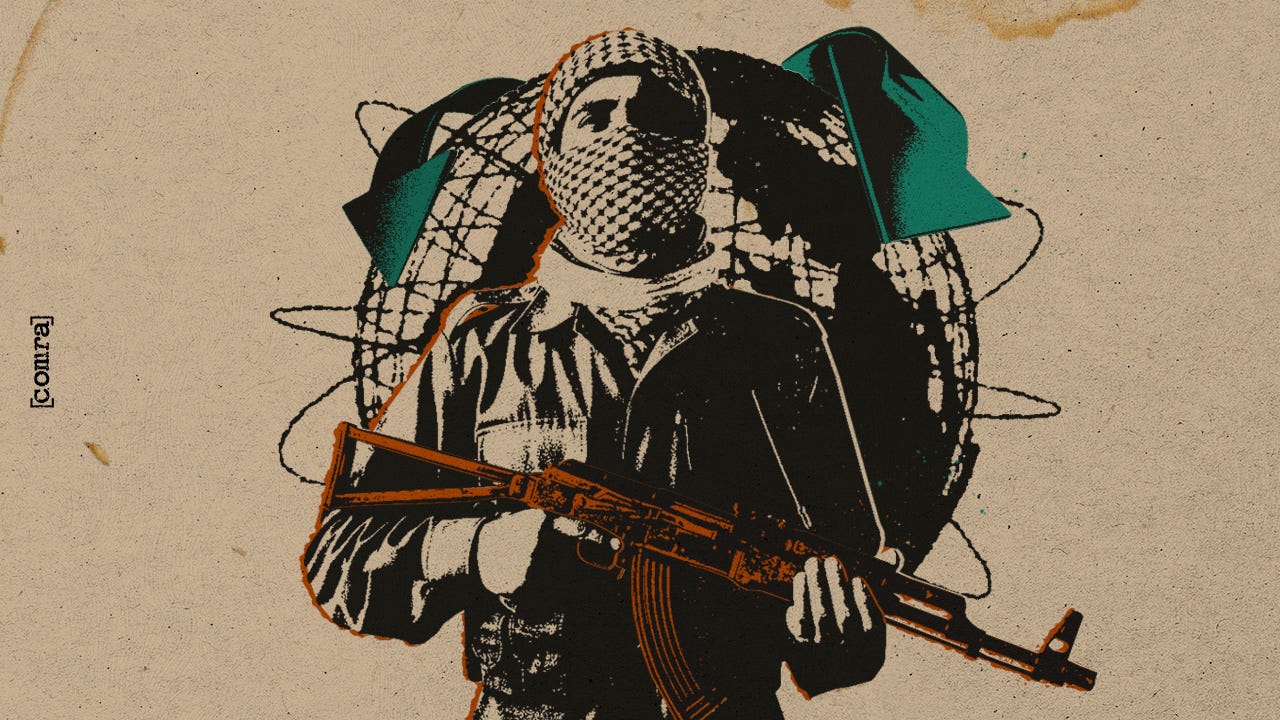
The shockwaves of the Al-Aqsa Flood still rattle the world two years on. Israel’s war machine failed to crush the Palestinian will to resist. Across the world, the genocide has left many overwhelmed and disoriented. Where do we go from here? [comra] sat down with anti-imperialist veteran Torkil Lauesen, known for his sharp analysis of geopolitics and resistance, interpreted through a Marxist lens.
“It is not just about solidarity with Palestine, what frightens the power, it is the idea that resistance against imperialism has become thinkable again,” Lauesen said.
In this interview, Lauesen reflects on the new generation of anti-imperialists shaped by October 7, how the Al-Aqsa Flood reshuffled the world’s political order, and what it means for the enduring struggle toward Palestinian liberation.
In the 1970s and 80s, Torkil Lauesen joined a clandestine Marxist organization in Copenhagen, Denmark. They funneled record sums of money from militant operations targeting banks to liberation movements across the Global South, with a strong focus on Palestine. Arrested in 1989 and sentenced to 10 years in prison, Lauesen used his time behind bars to study political science.
Today, he is recognized as a leading thinker on how imperialism operates in the modern world and how it can be dismantled through internationalist struggle.
[comra]: The world before and after October 7 feels unrecognizable. How do you assess the Al-Aqsa Flood operation’s impact on the Palestinian struggle and global power dynamics?
Torkil Lauesen: I like to view events from a long and global perspective. Furthermore, I am not a stateless Palestinian longing for statehood. As a communist, my perspective and goal are not just the national liberation of Palestine, but a socialist transformation, not only in Palestine, but through this struggle, for the whole Arab world. I am also well aware that it is easier to comment on the situation from a desk, safely located in Copenhagen, than it is when you are taking part in the struggle in the Middle East. I do not live in a war zone, where I would have to worry about my safety or where my next meal is coming from.
So, seen in a global perspective, the event of October 7 was a rather small operation, breaking out of the “open prison” called the Gaza Strip, and attacking the Israeli settler state for a day or two. However, the October 7 attack created an avalanche of events, an indication of how unstable the world system currently is.
First of all, the brutal response. It could not have been unexpected, remembering the Israeli invasion of Lebanon and siege of Beirut in 1982, to crush the resistance movement. It must have been a difficult decision to launch the attack on October 7. Was the resistance movement expecting a general uprising among Palestinians in the West Bank, Jerusalem and the ’48 Territories themselves? Had they hoped for military support from the surrounding Arab countries? Were they expecting China or Russia to intervene politically and block the Israeli response? If so, I would say that this was overly optimistic. China, Russia, and the surrounding Arab countries do not currently have the will or the means to directly confront an Israeli army backed by the US. Were they expecting that popular support in the West would pressure governments to abandon support for Israel? If so, I would say they were not being realistic.
The attack was a one-off event—a steam boiler exploding due to the pressure generated by decades of oppression. It was not a long-term strategy. The resistance movement will not be able to continue this kind of warfare, as its base in Gaza has turned into rubble and will be under direct occupation.
Does it mean that it is a total setback? I do not think so.
Israel has won a military victory in Gaza and Lebanon and in the confrontation with Iran. However, Israel has lost the war politically and morally. The US did not have the will or the ability to control its “mad watchdog” in the region. As a consequence, not only Israel but also the US and the West in general are losing credibility in the rest of the world.
The vast majority of the world’s nations and populations view the State of Israel with contempt. Gone is the sympathy for the Jewish settler state, outside of governments in the EU and North America. Their continued support has unmasked the hypocrisy of the Western powers’ talk of human rights and international law, for all the world to see.
In Palestine itself, Israel has sown the seeds for a new resistance movement more dedicated than ever to the struggle for liberation. How will Israel rule Gaza and the West Bank in the future? The task will be both economically and politically challenging. The Zionist settler state that once appeared solid and steadfast has proven to be fragile, crumbling from within and under growing pressure from the outside.
Here in the Global North, we have seen the rise of a new anti-imperialist movement, not seen since the Vietnam War, now based on solidarity with the Palestinian struggle. It is met by a Western discourse from the political establishment and mainstream media, which argues that “Yes, you are allowed to feel sorry for victims, but you cannot support the resistance movement to the atrocities, as they are terrorists.” This discourse hides the colonial reality of the conflict.
And the conflict is not just the colonial relation between Israel and Palestine, but the enforcement of a global imperialist structure beyond the geography of Gaza and the West Bank.
The State of Israel is an essential part of the architecture of a global order dominated by US hegemony. That is why Israel is portrayed as a friend in the West, with shared values and culture—as a European outpost—against the “barbarians” of the Middle East, as the founder of Zionism, Herzl, formulated it in the late 19th century.
The State of Israel ensures that the states of the Eastern Mediterranean and Middle East remain fractured and weak, thereby securing control of the trading routes between Asia, Africa, and Europe—the Red Sea and Suez Canal. Israel is a garrison state, a battleship on the ground. However, the State of Israel is not without cracks. It is the military violence in Gaza, the West Bank, Lebanon and Syria—in the whole region—that holds together a society that is fractured around ethnic, ideological, and class lines. Israel needs to continue this violent mode of governance; how else can it rule over Gaza and the West Bank? The violence is not a mistake or deviation from the liberal norms of “the only democracy in the Middle East”. It is the DNA of the apartheid settler state.
Israel is structurally indispensable for Western hegemony. To resist Israel, then, is not just to confront a settler colony. It is to confront a wider imperial grammar, which translates the act of resistance into terror. That is why Palestinians are denied the right to resistance, and support of the resistance is criminalized in the West.
The resistance struggle is necessary to end occupation, oppression, and exploitation. It is the refusal to be reduced to just victims. The insistence on resistance is also a manifestation of the political imagination of another world order, which is why it must be reduced to criminality.
“The international community” of North America and Europe registers the Palestinian resistance movement on lists as terrorists, in spite of the United Nations General Assembly having, in several resolutions, declared the right of a people under occupation to resist, also by means of armed struggle.
It is not just about solidarity with Palestine, what frightens the power, it is the idea that resistance against imperialism has become thinkable again. The Palestine solidarity movement has become a school in which people are learning about the colonial thinking of Western politicians, the hypocrisy of their talk about human rights, international law, the role of the mainstream “free press,” and so on. When resistance becomes thinkable and develops into a strategy, it is no longer geographically confined.
So, the Palestinian resistance should not only be measured by its military capacity. Israel will not be defeated in a military battle, but by the will to resist, as the US lost the war in Vietnam. Yes, the Israeli response to the resistance has inflicted huge suffering and casualties, as the response to the anti-colonial resistance in the 1960s and 70s caused millions to be killed in Algeria and Vietnam, for example. But the struggle created cracks in the imperial structure and expanded the horizon of another world order.
To a certain extent, the Palestinian resistance has proven the thesis of the Vietnamese general Võ Nguyên Giáp: “We know it’s the human factor, and not material resources, which decides the outcome of war.” In spite of Israel’s enormous superiority in terms of intelligence and weapons systems, the resistance movement in Gaza was able to build up its forces and launch its attack without being detected. Furthermore, it has been able to resist the response: total war from the Israeli war machine, fueled by massive arms shipments from the US.
There are important differences between the Palestinian and Vietnamese resistance struggles. The Vietnamese defeated first the French colonialists, then US imperialism, using the strategy of “people’s war” and the guerrilla tactics adapted by Ho Chi Minh and Võ Nguyên Giáp from the Chinese revolution. The Palestinians tried the same strategy, but lacking a secure rear base and the geography of vast jungles and mountains needed for such warfare, they were first driven out of Jordan in 1970, then Lebanon in 1982. To compensate for these geographical deficiencies, the resistance movement in Gaza constructed a comprehensive tunnel system and developed a new strategy of urban warfare against the Israeli army. This has enabled the resistance to survive under the most difficult circumstances for a long period—but it is not a long-term people’s war, and there is no North Vietnamese home base.
In Gaza, the homes of two million people are turned into rubble; there are no hospitals, no schools, no water, electricity, or sewage systems left. Over 50,000 have been killed, more than 100,000 injured, and forever physically handicapped, mentally devastated. People are locked up in a catastrophic environment, without the means for their own survival.
The Palestinian resistance must develop a comprehensive strategy for the struggle ahead—the struggle to create a secular state where different ethnocultural groups can live side by side. It will confront the politically weakened, but still militarily strong, settler state, however, depending on the continued support of the US. Such a strategy needs to coordinate the struggle not only in Gaza, but also in the West Bank, the ’48 Territories, and the Palestinians in the diaspora. It needs to be embedded in the anti-imperialist struggle in the region and in the global confrontation between declining US hegemony and the rise of the Global South.
[comra]: You predicted the Gaza war would accelerate US decline and fuel a multipolar world. Today, that shift is visible, yet many would say Palestine now stands on the brink of extinction. How accurate was your prediction that a multipolar world would tilt the balance in Palestine’s favor?
Torkil Lauesen: I do not think Palestine is on the brink of extinction, and I still think the development of a multipolar world opens up new possibilities for the struggle. Imperialism is in crisis. The West has lost its economic superiority in both quantitative and qualitative terms. As South-South trade and political cooperation increase, the West’s financial dominance is challenged. The ruling class is bewildered; they can no longer rule as they did in past decades. They are turning from globalization to narrow nationalism, which is dividing them. The turn to renewed military geopolitical struggle is not a symbol of strength, but weakness.
The Palestinian struggle should benefit from the decline of the US in global economics and politics and incorporate this into its future strategy. The struggle for Palestine exists in the context of the dramatic global process of transformation that is currently unfolding. In practical terms, the path forward involves coordinating the struggle with the surrounding Arab world and the Global South in general against imperialism. The attack of October 7 has pushed to “the West vs. the Rest” contradiction reflected in the UN votes on the war in Gaza. It is among the “Rest”—the Global South—that Palestine can find its strategic allies.
Progress in the struggle in the region depends on the continuing decline in US hegemony. For the time being, the US’s main adversary seems to be Russia. However, this is only on the European front; in economic terms, Russia is no match for the US, and in strategic terms, a right-wing nationalist Russia is no reliable ally of the Palestinian struggle, despite its rivalry with the US.
China, however, is abandoning neoliberalism and sliding to the left. China is pushing for a more multipolar world order from a position of economic and political strength. In recent years, China has given material and diplomatic support to countries in the Global South that are facing US economic and political pressure, such as Cuba, Venezuela and Iran. China is establishing economic and political cooperation with more and more countries in Asia, Africa, and Latin America, such as India and Brazil. This will create new cracks and fissures in which the anti-imperialist movement can once again go on the offensive.
It is important to take advantage of the opportunities this situation presents. The Palestinian Left must revitalize its relationship with China to gain support for the Palestinian cause. In 2016, China voted to support a UN Security Council Resolution reaffirming the illegality of Israel’s settlements and “Condemning all measures aimed at altering the demographic composition, character, and status of the Palestinian territory occupied since 1967, including East Jerusalem.” In July 2024, representatives of 14 Palestinian organizations met in Beijing and signed a new agreement on unity. The boycott movement should appeal to the Chinese government to stop investing and trading with Israel, leading a boycott movement similar to that against South Africa in the 1980s.
[comra]: October 7 sparked a surge of politicization and anti-imperialism, even in imperialist centers. However, the revolutionary beacons of the 1960s are long gone. How can this new generation of young anti-imperialists navigate this disorientation?
Torkil Lauesen: As mentioned above, the new anti-imperialist layer in “the belly of the beast” is learning quickly. It has moved from narrow solidarity with Palestine to a broader understanding of the global imperial structure. The old ‘68 generation, to which I belong, should assist this by handing over its knowledge, remembering that you cannot copy and paste experience across time and space; it has to be adjusted to the current situation.
The solidarity is facing criminalization, even targeting verbal support, as in Germany, where the shouting “From the river to the sea, Palestine will be free” is an offense. Similarly, in the US, student demonstrations had led to the dismissal of students and professors from universities. In the UK, supporters of direct actions have been arrested by the hundreds. I think the repression will grow; the movement should prepare for this on both personal and organizational levels.
[comra]: The post-October 7 surge in anti-imperialist sentiment in Palestine differs from the 1960s movement: socialist forces no longer lead. How do you assess this shift, and what challenges or consequences does the absence of a socialist framework pose for today’s anti-imperialist generation?
Torkil Lauesen: I think this is a bit of a Western-centric view. For sure, “socialism” has been in crisis in the West since the mid-80s, and the “socialist spirit” has also been extinguished in part of the Global South. However, I think that the “socialist framework” for a future transition to a socialist world order is better today than in the 60s and 70s. Why so?
China, consisting of 1.4 billion people and now the leading global industrial power, has broken two centuries of Western dominance. In the 70s, the Third World demanded another world order; today, they are building it. In the 70s, the ruling class was able to launch a potent counter-offensive in terms of neoliberal globalization. Today, the ruling class is bewildered and split. The global South is on the offensive on the economic front. While the transformative power of the Third World in the 70s was based on the “revolutionary spirit”—the attempted ideological dominance over economic development—the current transformative power of the Global South is based on its economic strength.
China is not a socialist country; it is what we call a transitional state. But it has the intention to develop socialism. This is repeated again and again by a Communist Party, with 100 million members, holding state power. Politics is in command in China. It is not just words. Since the end of “the opening up neoliberal period” around 2015, China has been moving steadily to the left. China has specific plans and a vision for developing advanced socialism in the coming decades. The West has turned into a pessimistic and paranoid defense mode. Today, the transitional mode of production has been shown to be more effective and innovative than the capitalist mode. I think many countries in the Global South will look towards China for a new course of development.
[comra]: Let’s move on from discussing the Global North. Arab populations in neighboring countries appear paralyzed on Palestine’s national liberation. Why is that? Why aren’t we seeing major uprisings after one of the 21st century’s most shocking regional events?
Torkil Lauesen: Historically, the Palestinian struggle has been closely linked to the regional Arab struggle. Pan-Arabism was a strong current in the region in the 1950s and 60s. However, the progressive, petit-bourgeois Arab states of the past do not exist anymore. Instead, we have a Syrian state that was torn to pieces by civil war and now is a weird state governed by an Islamic militia, supported by the US and EU, and militarily controlled by Israel. Libya is also a state in crisis, torn apart by sectarian strife. After two imperialist wars, Iraq still needs US and NATO troops to maintain a pro-Western government in power over a divided nation in economic crisis. Lebanon has been thrown into political chaos by an incompetent and corrupt political clan system and is in deep economic and social crisis. On top of this came the war between Hezbollah and Israel in the context of the Gaza war. No real support can be expected from these states. However, the class struggle in these states is of vital importance.
The Palestinian struggle has received support from Iran and its local allies, such as Hezbollah. However, Iran has its own agenda in its confrontation with the US and Israel. It is important to be aware of the limitations in the alliance with Iran and Hezbollah.
The main driver in the liberation struggle in the Third World in the 1960s and 70s was the establishment of independent nation-states. It was mainly a national liberation struggle. Today, the main drivers in the Global South are economic and social liberation. This was the agenda of the Arab Spring in 2011. The Arab Left, however, was nonexistent or simply not able to provide the strategies and organizations to take these uprisings from demonstrations on the streets and squares to more effective and coherent forms of struggle. Now is the time to expand the agenda of national liberation and place emphasis on the elimination of poverty, labor struggles, social issues such as housing, health, education, women’s liberation, the rights of ethnic minorities, and the rights of sexual minorities—in short, socialism.
The Arab reactionary forces, mainly located in Saudi Arabia and the other Gulf states, have become even more important allies for the US, particularly in its confrontation with Iran. However, in March 2023, with China as mediator, Saudi Arabia and Iran restored diplomatic relations, which contributed to a de-escalation of the conflict in Yemen.
Furthermore, Saudi membership in BRICS+ and the possibility of selling oil to BRICS+ partners in local currencies instead of dollars have irritated the US. Finally, the Gaza War has interrupted the process of normalization between Saudi Arabia and Israel, which seemed likely to result in an agreement like the Abraham Accords, which Israel signed with Bahrain and the UAE, respectively, in September 2020, later joined by Morocco and Sudan. The signing of a similar agreement with Saudi Arabia would, according to Trump, usher in a new chapter of Arab–Israeli collaboration, forge a strong regional bulwark against Iran, and advance a “durable resolution” to the Israeli–Palestinian conflict—“The dawn of a new Middle East.” The current split between the interests of Arab reactionaries and the US is to the advantage of the Palestinian resistance, but we should not have any illusions. The Arab reactionaries are still a strategic ally of imperialism and are definitely still an enemy.
The Arab response at the state level to the war in Gaza has been marked by cowardice and narrow interest, by the elite in power, bound by regime security and fear of popular revolt. However, at the popular level, there is a new grassroots Pan-Arabism forged through shared outrage and shared refusal of the remnants of colonialism. It still needs to be organized; however, a reawakening of Arab political consciousness, not from above but from the ground up, might be a game-changer. The liberation of Palestine will be an isolated event, but embedded in a transformation of the region.
[comra]: The Iran-led “Axis of Resistance” has faced major military and political setbacks. The Palestinian resistance has also shifted—from socialist-led movements to today’s Islamist-nationalist leadership. What can we expect for the future of resistance movements in the region?
Torkil Lauesen: The Axis of Resistance was never a coordinated command structure. It is a loose, tactical network of forces in opposition to the US-Israeli hegemony in the region. Despite Hezbollah’s defeat in Lebanon and Iran’s loss in the confrontation with Israel, the success of the latter should not be overexaggerated.
Israel has not achieved total victory in Gaza after years of intense war, despite its overwhelming force. This shows the limits of the settler-colonial project. It can destroy Gaza but not rule it. It can displace the Palestinians but not eliminate them. Israeli military violence has defeated states and scared other states into passivity, but it has also raised dispersed, decentralized and transnational forms of resistance and solidarity with Palestine.
So, the resistance will not disappear but change its form. Resistance, as Palestine has taught us again and again, is not reducible to its institutions. It changed its form after the events of “Black September” in Jordan in 1970, relocating to Lebanon. It changed its form after the Israeli invasion of Lebanon in 1982 and the expulsion of the Palestine Liberation Organization (PLO) from Beirut. The task is to develop a strategy to sustain resistance for the long term and generate forms of struggle that do not end in one blow or another.
What is the imperialist planning that the resistance is up against? One scenario is the expulsion of the population from Gaza to Egypt and Jordan, making Gaza part of Israel, together with the annexation of the rest of the West Bank by settlers.
Another is to initiate a “two-state peace process,” leading to the establishment of some kind of Palestinian state that would not challenge Israel’s position as the region’s ruling power. It will consist of some scattered pieces of land, without the institutions needed to control or protect itself. The problem with that plan—besides Israel’s total refusal—is to find a legitimate Palestinian representative for such a “Mickey Mouse state”. Popular support for the so-called Palestinian Authority (PA) in the West Bank is very limited. If and when we see construction of such a project, we will see a massive influx of Western NGOs and capital from the Gulf states, trying to establish and prop up just such a Palestinian representative.
[comra]: What could be done to develop a strategy to counter these plans?
Torkil Lauesen: The Palestinian proletariat is the main force of the revolution; however, we need a concrete class analysis with a focus on how the different classes can contribute to the struggle. Such an analysis must include the lumpen proletariat, which is a significant part of the Palestinian population. How can they be mobilized and organized? How can they contribute to the struggle?
The same goes for Palestinians in the diaspora. They have to be an integral part of the strategy. The analysis has to take into consideration what part of the world they live in, their class status, and their aspirations in life. They can support the struggle materially and politically. They can organize the anti-apartheid and boycott struggle internationally. They can help to connect the struggle in Palestine with other revolutionary struggles around the world to strengthen practical and political cooperation internationally.
But where to begin? Resources are limited, and disorientation is widespread. Pessimism is understandable. But it is also grist for the enemy’s mill since it seems to confirm that resistance is futile. I believe there is reason for optimism. We see changes at the global level not seen in a hundred years. The decline in US hegemony and the economic, political, and ecological crises of capitalism open up possibilities for change.
The problem is the subjective forces. In the 1970s, millions were mobilized in the struggle against imperialism by a socialist revolutionary spirit, consisting of a vision of the goal and a strategy to reach it. The task at hand is to provide the same for today’s struggle. There is currently a lively debate going on in Palestinian circles about the future organization of the resistance and how to envisage a future Palestine.
The people of Palestine want to be free of oppression, and they want a solution to their social and economic problems. Whatever we do, the struggle will continue. The Palestinian people will rise up repeatedly against oppression—they have no other choice. For now, some seek answers in political Islam, others hold out hope for liberal democracy in combination with a capitalist welfare state, while others are just confused and disillusioned. The PLO is without its former strength. The PA regime on the West Bank is discredited. Islamist forces have far greater support than the Left, which has been reduced to a small minority.
This does not mean that the struggle for a socialist Palestine is hopeless. The question is how to proceed with this struggle in the short and long term. On the one hand, the Popular Front for the Liberation of Palestine (PFLP) and other progressive forces risk being tactical pawns for Hamas if they back their political line just for the sake of unity. On the other hand, the weakening of the Zionist state is a precondition for any progressive development. To achieve this, the immediate goal could be to establish a democratic secular state. I think such a demand has potential not only in Palestine but in the Middle East more broadly. The recent uprisings in Lebanon and Iraq show that people are fed up with sectarian politics, where clans, corruption, and nepotism rule in conjunction with neoliberal economics.
This does not mean that the Left should be shy about promoting a socialist agenda—on the contrary. In the struggle for a secular state, the Palestinian Left should not give in to conservative norms; it should develop a program for a specifically Arab socialism.
One thing is certain: the struggle continues. The experience of the Palestinian anti-imperialist struggle in the late 1960s and early 1970s remains an integral part of the memory of the global anti-imperialist movement. The PFLP is held in high esteem. Many are waiting for the Palestinian Left to rise again and lead the struggle in the Arab world.
Revolutionary anti-imperialism can be resurrected in the years to come, as the intensity of class struggle around the world once again calls for radical alternatives. At a time when US hegemony is in decline and global power relations are complex, we will see unexpected and rapidly shifting conditions for the struggle. We must prepare for such events by developing a new strategy for the liberation of Palestine.